ElliShape (Morphology Analysis tools)
介绍
物种的形态变异普遍存在于地球上的所有生命之中。准确捕捉并全面解析生物形态及其变异,对于理解形态与发育及环境驱动力之间的内在联系至关重要。几何形态测量学为高维生物形态的定量分析提供了数学工具,被誉为形态测量学领域的一场革命。椭圆傅里叶分析是几何形态测量学中常用的方法,但椭圆傅里叶描述子的归一化问题长期存在,导致研究者难以获得唯一且可比较的结果,尤其是对于基于轮廓线法的几何形态测量应用。这限制了该方法对高通量、高变异、高维度的生物形态进行自动化分析的能力。
我们提出了一种椭圆傅里叶描述子完全归一化方法,理论推导证明,该方法在所有基本轮廓变换下均能得到一致的归一化的结果。在此基础上,我们引入了最小欧式距离方法,开展基于归一化描述子重构形态的定量比较,该方法在数学上保证了结果的唯一性和可比性。基于这些改进,开发ElliShape软件,三个版本适应多种应用场景:命令行版本支持自定义参数的批量处理;图形用户界面版本集成了Segment Anything模型,可实现器官的自动分割;Web版本则提供免安装的便捷访问方式。
我们使用基准数据集对椭圆傅里叶描述子完全归一化方法进行了逐一验证。同时,我们对86个物种的1338个叶片形状进行了定量形态分析,构建的形态树显示聚类模式与叶片椭圆度和裂叶程度的变化密切相关。
完全归一化的椭圆傅里叶描述子及其对应的轮廓可进一步用于深度学习的训练以实现精确的物种识别。此外,几何形态测量学与机器学习的结合在整合分类学、生物多样性保护、物种分类及生态系统功能评估等方面具有重要价值,从而推动形态大数据驱动的跨尺度生物学研究。
下载与编译
您可以下载图形用户界面(GUI)应用程序和便于批量处理的命令行(CLI)脚本应用程序。
文章使用的相关ElliShape训练数据集可在此下载:https://www.plantplus.cn/ellishape/file/ElliShape_training_Dataset.zip。
在线演示
我们已成功推出在线试用版本,旨在鼓励全球公众积极参与到标本数据的探索和挖掘。
Introduction
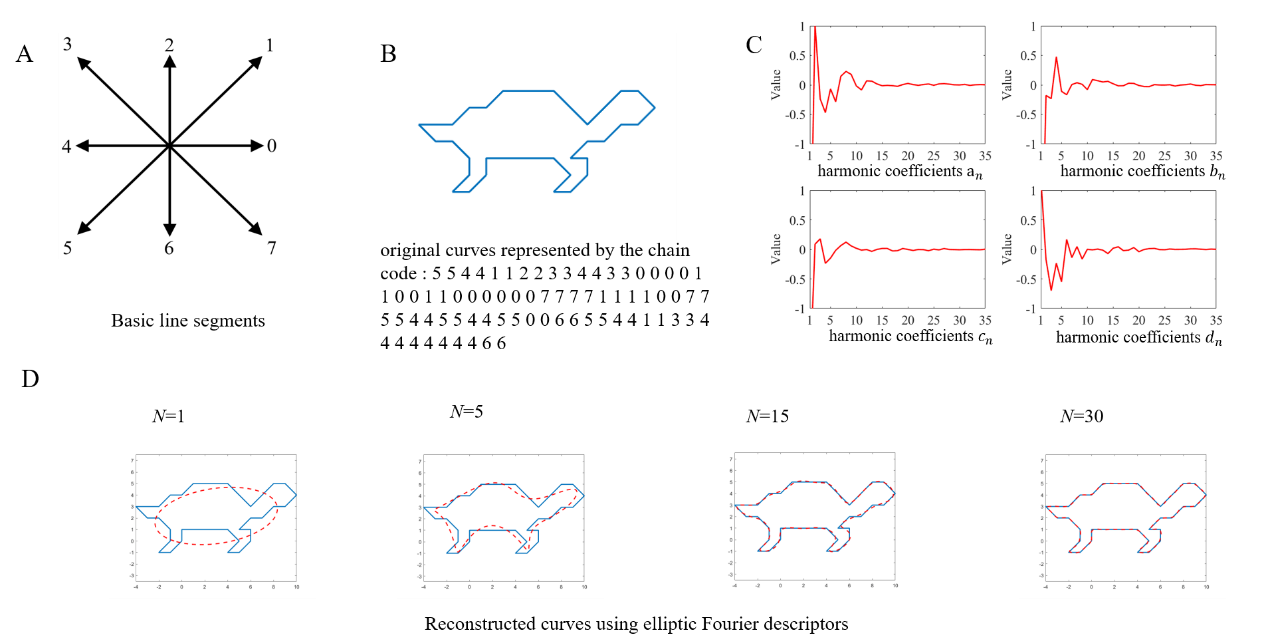
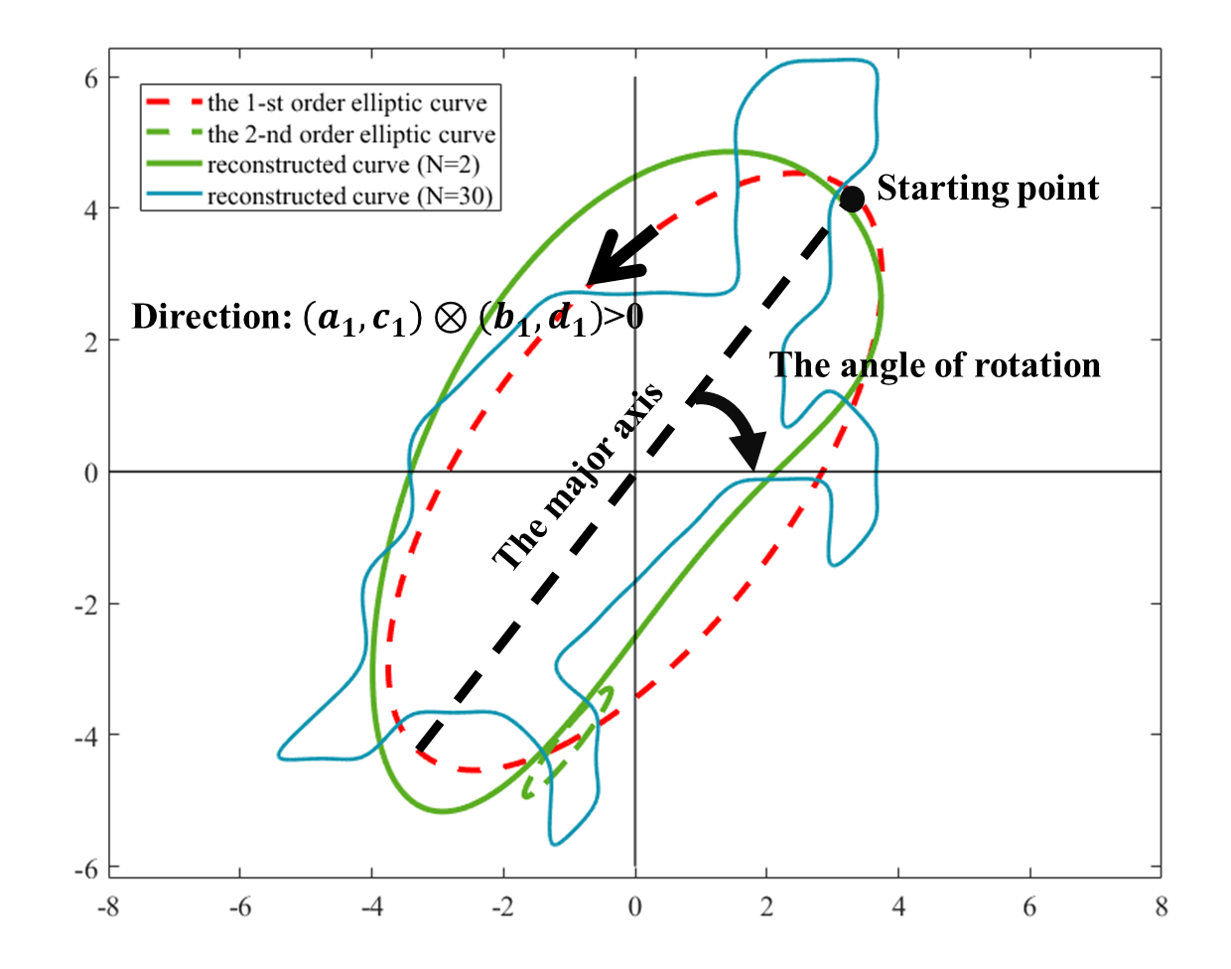
Morphological variations, both within and between species, occur pervasively throughout life on Earth. Accurately capturing and comprehensively analyzing biological morphology and its variations are crucial for understanding their interconnections with developmental and environmental forces. Geometric morphometric (GM) offers mathematical tools for quantitative analysis of multi-dimensional biological forms, which was thought to be a revolution in morphometrics.Elliptic Fourier analysis (EFA) is often employed in geometric morphometrics (GM), but the normalization of elliptic Fourier descriptor (EFD) has persistently posed challenges for obtaining unique and comparable results, especially in the application of outline-based GM methods, which limits the implementation in automated analysis of numerous, highly variable, and multi-dimensional biological forms.
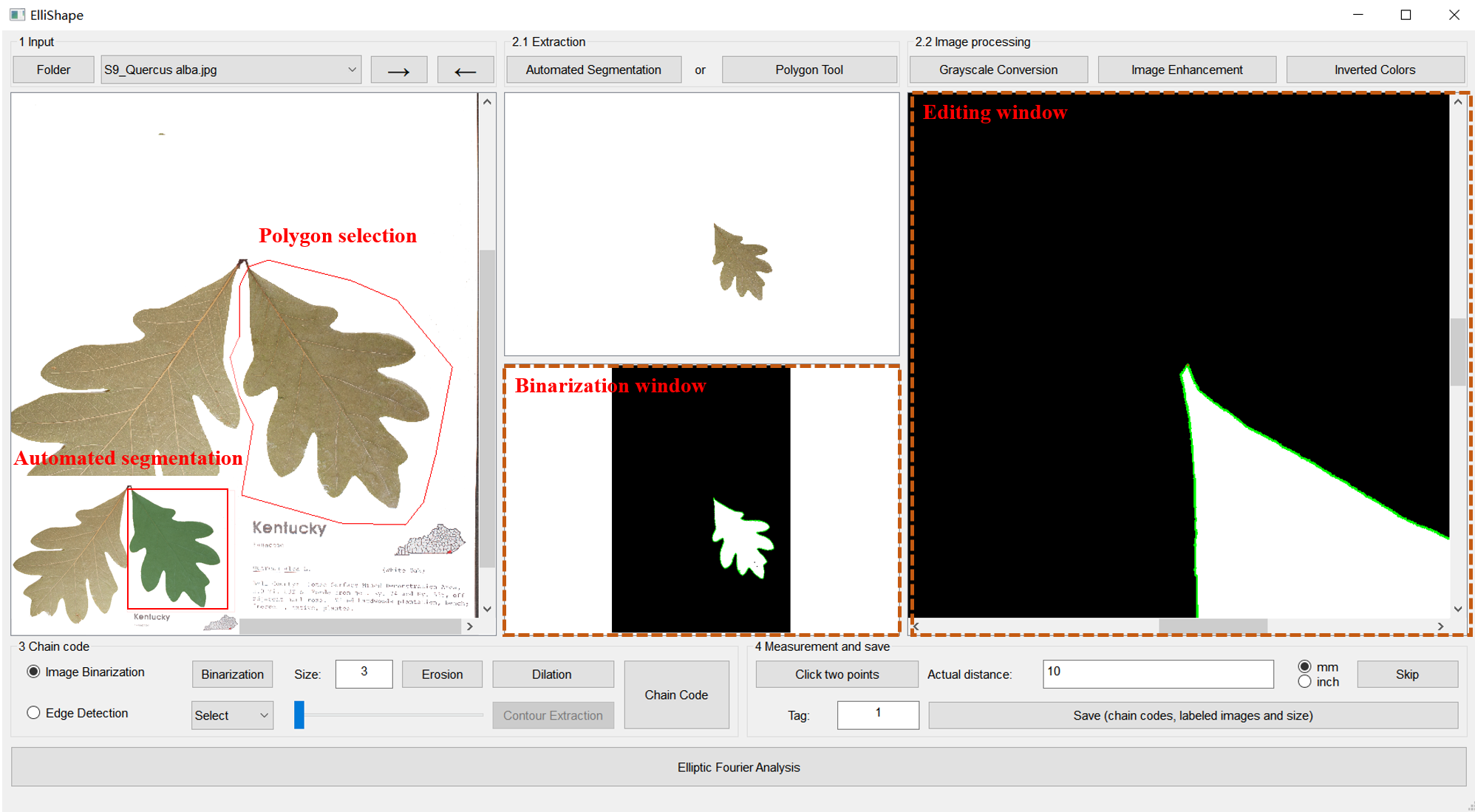
We introduce an approach for complete elliptic Fourier descriptor (EFD) normalization, which remains constant under all basic contour transformations with theoretical derivations. Accordingly, we propose to use minimum Euclidean distance between two shapes reconstructed by completely normalized EFDs for quantitative morphological comparisons, which is mathematically guaranteed to obtain unique and comparable results. Based on these improvements, we developed ElliShape software in a command line version, a graphical user interface (GUI) version, and a web version, which are suitable for batch processing with customizable parameters, automatic organ segmentation with segment anything model (SAM), and convenient access with zero installation, respectively.
The proposed complete EFD normalization procedure is validated using a benchmark dataset. Using the proposed quantitative morphological analysis, we compared 1,338 leaf shapes from 86 species and constructed a morphological tree. The resulting tree shows clustering patterns linked to variations in leaf ellipticity and lobation.
The completely normalized EFDs and corresponding contours can be further utilized in deep learning-based data training for accurate shape identification. Moreover, the integration of geometric morphometrics and machine learning is very useful for integrative taxonomy, biodiversity conservation, species classification, and ecosystem function assessment, thereby promoting cross-scale biological research driven by morphological big data.
Download and compile
You can download the application with GUI and the application with command line scripts.
Please refer to the English and Chinese manuals for usage instructions.
The relevant ElliShape training Dataset used in this paper is available here, https://www.plantplus.cn/ellishape/file/ElliShape_training_Dataset.zip.
Online demo
We have successfully developed and launched the online demo, to encourage global public participation in specimen exploration.